Is AI Bad for the Environment? Start With What's Measured
Most figures on AI's environmental cost are multiplied from one measured number, electricity. Where the others come from, and what gets left out.
By Cogniq Labs ResearchEvidence policy
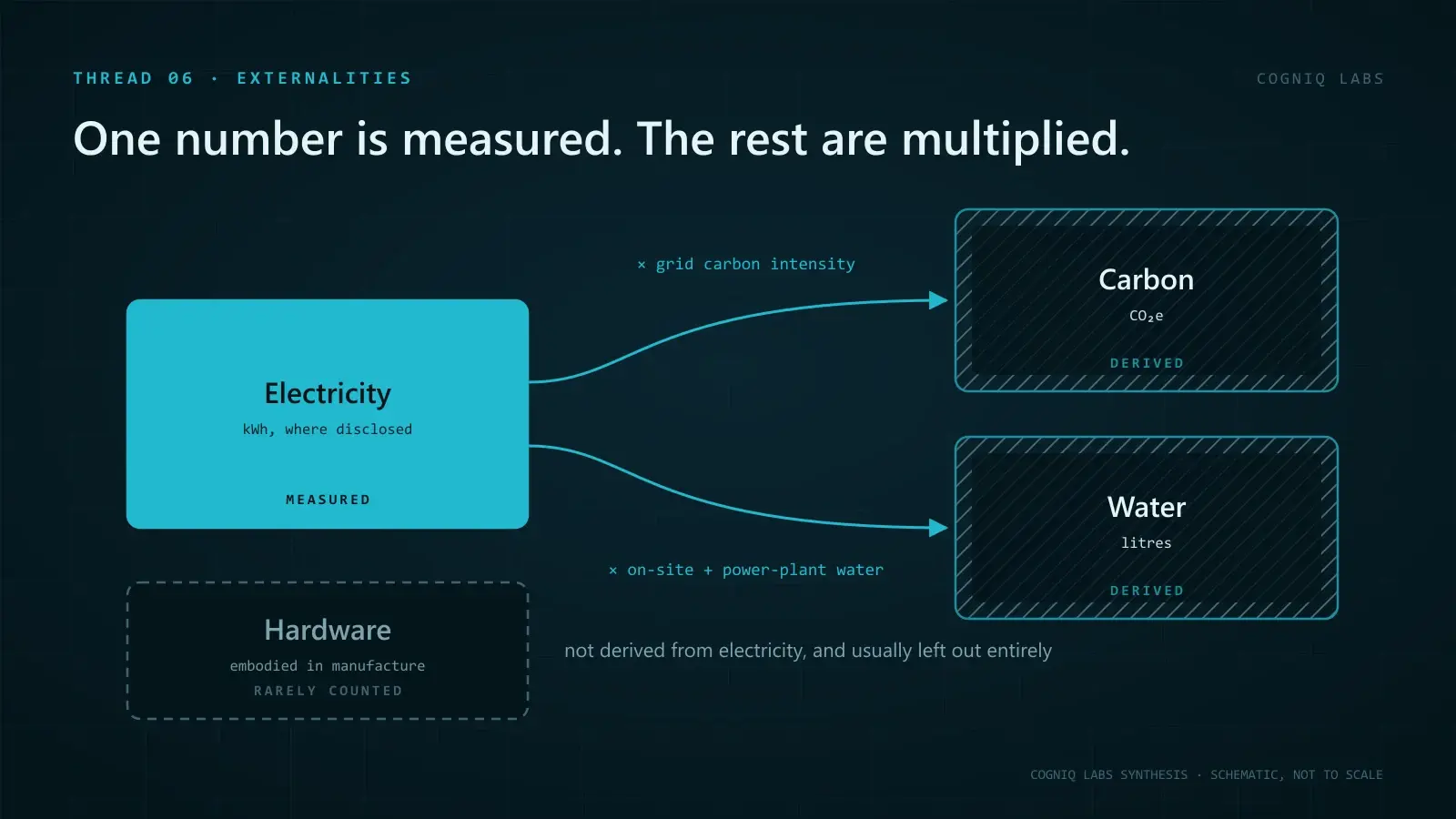
Ask whether AI is bad for the environment and you will find confident answers in both directions, often citing numbers that differ by orders of magnitude. The disagreement is less mysterious once you see how the numbers are made.
Almost every figure you encounter is built from a single measured quantity, electricity, multiplied by assumptions. Understanding which figures are measured and which are multiplied does more to answer the question than any headline.
The short answer
AI has a real environmental footprint, and it is growing as usage grows. It shows up in four places:
| Quantity | How it is usually obtained |
|---|---|
| Electricity | Measured, at facility level, where disclosed |
| Carbon | Electricity × carbon intensity of the grid |
| Water | Electricity × water intensity, on site and at the power plant |
| Hardware | Manufacturing emissions, rarely included |
So "how bad" depends on which row you mean, where the computing happens, and what you are comparing it with. Anyone offering a single number has made choices in each row, whether or not they state them.
One number is measured
Electricity is the quantity closest to direct measurement. Data centre operators meter it, some disclose it in sustainability reporting, and some model developers disclose the energy used to train particular models.
Even here the coverage is partial. Facility totals rarely separate AI from everything else a data centre does, and per-model or per-request energy is disclosed by some companies and not others. But this is the one row where a figure can trace back to a meter.
Carbon is multiplied from it
Carbon is typically electricity multiplied by the carbon intensity of the grid that supplied it. The same kilowatt-hour produces very different emissions on a coal-heavy grid than on a hydro-heavy one, and intensity also shifts through the day as the generation mix changes.
A second layer of variation comes from accounting method. Companies can report emissions based on the grid their facilities actually draw from, or adjusted for renewable energy they have purchased. Both methods are recognised, they can give very different results for the same physical electricity, and summaries frequently do not say which was used.
Water is multiplied too
Water has two parts, and both are usually calculated from electricity: water evaporated on site for cooling, and water consumed at the power plants generating the electricity.
We have covered this in detail. Per-prompt water estimates differ by roughly two thousand times mainly because some include the power plant term and some do not. And a facility's own consumption depends heavily on its cooling design, because water is largely a substitute for electricity in cooling, not an extra cost on top of it.
Hardware is mostly left out
The fourth row sits outside the multiplication entirely. Manufacturing chips, servers and buildings produces emissions before any computation runs. Because it is not derived from electricity use, it is absent from any figure built by multiplying kilowatt-hours, and per-query estimates almost never include it.
As accelerators are replaced on short cycles, this share is not trivial, and its absence biases most published figures downward.
Training versus inference
Early attention focused on training, because a single training run is a large, discrete, reportable event. Inference is smaller per request but runs continuously at very high volume.
A scoping review of AI carbon accounting notes that earlier studies concentrated on training while the cumulative footprint of inference at scale received comparatively less attention. It also identifies system boundary definitions as a major driver of the results, which is the same problem this note is describing from another angle. The MIT News explainer is a useful non-technical overview of both phases.
So, is it bad?
The honest answer comes in two parts.
Per request, the cost is small. A single query is a modest amount of electricity, and most comparisons with everyday activities make it look minor.
In aggregate and locally, it is significant. Total demand is growing, and impact concentrates where facilities are built. A data centre drawing on a strained grid or a stressed aquifer matters to the people sharing those resources, whatever its global average looks like. Power and water availability now shape where large clusters can be built at all.
Both statements are true. Arguments that quote only one of them are usually making a case, not answering the question.
How to read the next figure you see
Before accepting any claim about AI's environmental cost, ask three questions:
- Which quantity is it? Electricity, carbon, water and hardware are not interchangeable, and only the first is usually measured.
- What converted it? For carbon, which grid and which accounting method. For water, whether the power plant is included.
- Is manufacturing in or out? If the figure was built from kilowatt-hours, it is out.
A claim that answers all three is worth weighing. One that answers none is an opinion with a number attached.
What we do not know
There is no standard for reporting AI's environmental footprint, so figures from different sources are rarely comparable. The Federation of American Scientists argues for measurement standards precisely because boundaries are currently set by whoever does the counting.
We do not have a defensible per-query figure that covers all four rows, and we are sceptical of anyone who presents one without stating their boundaries. The electricity figure is measured, sometimes. Everything past it rests on factors that should be disclosed alongside the result and usually are not.
The figure in this note may be reused with attribution and a link to this page.
Sources
Frequently asked questions
Is AI bad for the environment?
It has a real and growing footprint in electricity, carbon, water and the hardware it runs on. How large depends on which of those you mean, where the computing happens and what you compare it with. Of the four, only electricity is routinely measured; the others are mostly calculated from it, which is why published figures disagree so widely.
Is training or inference worse for the environment?
Training is a large one-off cost; inference is smaller per request but runs continuously at enormous volume. Research attention historically focused on training, while reviews of the field note that the cumulative footprint of inference at scale has been comparatively understudied.
Why do AI carbon estimates vary so much?
Carbon is usually electricity multiplied by the carbon intensity of the grid supplying it, and that intensity changes by region and by hour. Companies also report emissions under different accounting methods, with and without renewable energy purchases, so the same electricity can produce very different published figures.
What is embodied carbon in AI hardware?
It is the emissions from manufacturing the chips, servers and buildings, before any computation happens. It is not derived from electricity use, so it is missing from any figure built by multiplying kilowatt-hours, and per-query estimates rarely include it.
How can AI's environmental impact be measured better?
By reporting electricity at facility and workload level with stated boundaries, disclosing the carbon and water intensity factors used to convert it, and including manufacturing emissions. Standardising those boundaries matters more than any single headline figure.
Related reading
What a Data Centre Actually Does With Water
Cooling is a heat transfer problem with several solutions. Which one a facility uses decides whether it consumes water, electricity, or land.
Why AI Water Estimates Differ by 2000x
Published figures for water per AI prompt range from 0.26 millilitres to over 500. Both are defensible. The gap is entirely in what each one counts.
What a $50M Cluster Actually Buys You
GPU count is the least interesting number in a cluster. Power, cooling and interconnect decide what the money actually turns into.