What the KV Cache Actually Costs You
The KV cache makes generation fast and quietly decides how many requests a GPU can serve. Why it grows with every token, and what shrinks it.
By Cogniq Labs ResearchEvidence policy
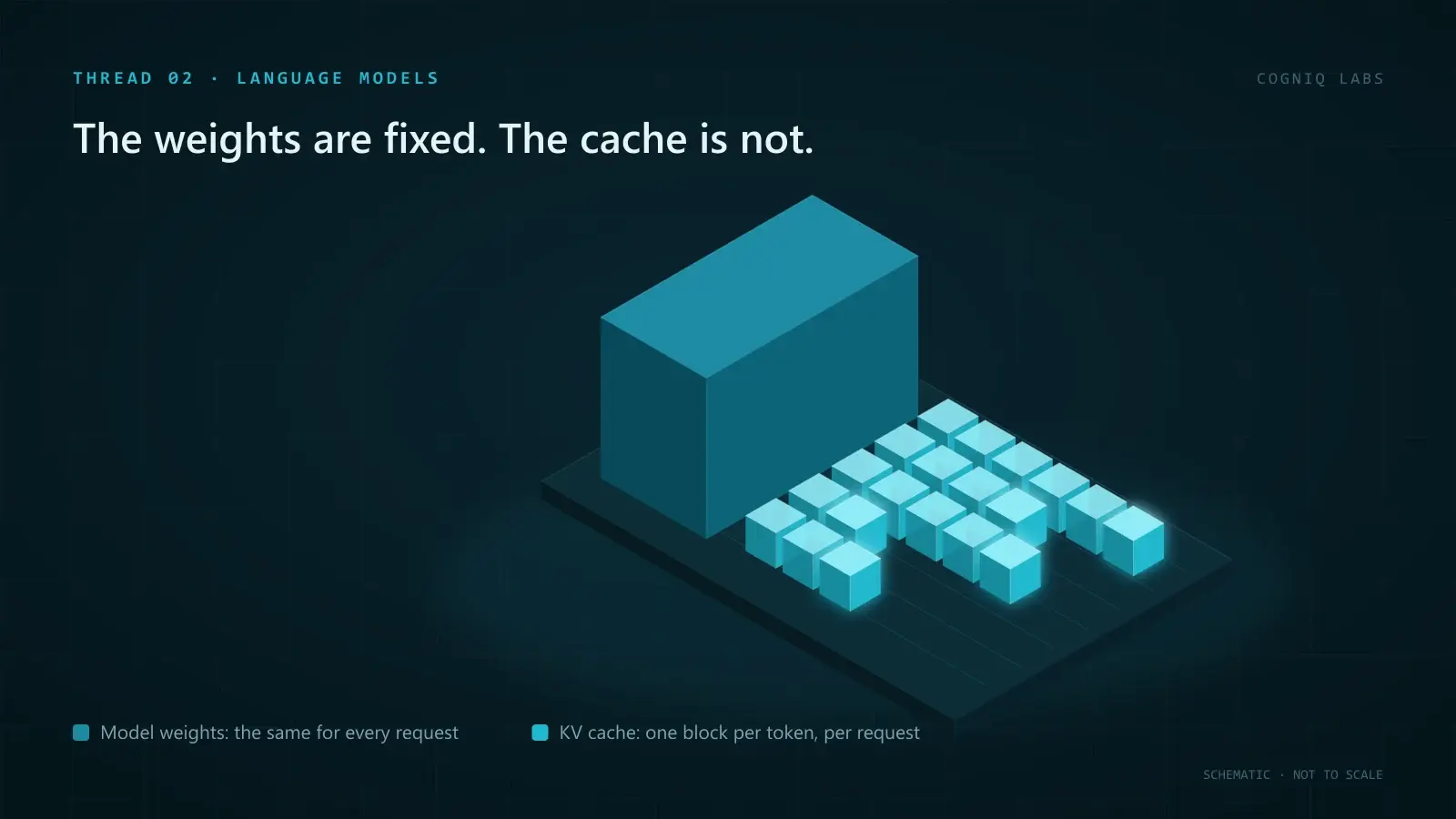
A served language model has two big things in GPU memory. The weights are the famous one, and their size is printed on the model card. The other is the KV cache, which is rarely mentioned, grows with every token of every request, and on long prompts quietly decides how many users one GPU can serve.
What it is
To produce each new token, a transformer attends over every token that came before it. Without a cache, generating the hundredth token would mean recomputing the keys and values for the ninety-nine before it, and again for the hundred-and-first, and so on.
The KV cache stores those keys and values once and reuses them. It is the reason generation is fast. The price is memory, held for the whole life of the request.
Why it grows
The cache size is a product of five things:
| Factor | Grows when |
|---|---|
| Layers | The model is deeper |
| Key-value heads | The attention design keeps more of them |
| Head dimension | The model is wider |
| Sequence length | The prompt and output get longer |
| Concurrent requests | More users are served at once |
The first three are fixed by the model. The last two are set by your traffic, which is why the cache behaves so differently from the weights: the weights cost the same whether one person is using the model or a thousand, and the cache does not.
A worked example
The following is illustrative arithmetic for a hypothetical 70-billion-parameter model with 80 layers, 8 key-value heads of dimension 128, stored at 16-bit precision. It is not a measurement of any product.
Each token stores a key and a value in every layer and every key-value head:
2 × 80 layers × 8 heads × 128 dimensions × 2 bytes ≈ 320 KB per token
At an 8,000-token context that is roughly 2.6 GB for a single request. Thirty-two such requests at once need about 84 GB of cache, on top of roughly 140 GB of weights.
If the same model kept a separate key and value for each of 64 attention heads instead of sharing 8, every one of those figures would be eight times larger. That difference is not an implementation detail. It decides whether the deployment fits on the hardware at all.
Two phases: where the cache is built and where it is read
Serving a request happens in two phases with very different costs.
Prefill processes the whole prompt at once. Every prompt token's keys and values are computed in parallel and written into the cache. This phase is dominated by arithmetic, and it is what you wait for before the first token appears. A longer prompt means a longer prefill, which is why time to first token rises with prompt length.
Decode then generates one token at a time. Each step reads the model weights and the entire cache built so far, does a comparatively small amount of arithmetic, and appends one more entry. That makes decoding limited by memory bandwidth rather than compute. The multi-query attention paper names exactly this problem: incremental decoding is slow because of the memory-bandwidth cost of repeatedly loading the large key and value tensors.
So the cache costs you twice. It occupies memory that could hold other requests, and it has to be read in full for every token generated, so each new token of a long conversation is slower to produce than the last.
Why it sets the price
Memory left over after the weights determines how many requests can be batched together, and batch size is what turns a GPU into throughput. A bigger cache per request means fewer requests per GPU, and fewer requests per GPU means a higher cost for every generated token.
This is also why long prompts are disproportionately expensive to serve, and part of why the tokens in a long context are not free even when the model handles them well.
What shrinks it
Share the keys and values across heads. Multi-query attention keeps one set of keys and values for all heads, which its author proposed precisely because loading these tensors was the bottleneck in decoding. Grouped-query attention shares a set across each group of heads, and its authors report quality close to full multi-head attention at speed comparable to multi-query. The hypothetical model above already uses this; it is the reason the cache is eight times smaller than it would otherwise be.
Stop wasting the memory you have. Early serving systems reserved one contiguous block per request, sized for the longest output it might produce. PagedAttention, the technique behind vLLM, manages the cache in small fixed-size pages instead, the way an operating system manages memory. Its authors report near-zero waste, sharing of cache blocks within and across requests, and two to four times the throughput of the systems they compared against at the same latency.
Send less context. The cheapest token to cache is the one you never send. Retrieving a few relevant passages instead of whole documents cuts the cache along with everything else, and a long prompt is not guaranteed to help anyway, since models often miss what sits in the middle of it.
How to estimate it for your own model
You do not need to trust anyone's figure. The calculation needs five numbers, all of which appear in a model's published configuration:
| You need | Where to find it |
|---|---|
| Number of layers | Usually listed as the number of hidden layers |
| Number of key-value heads | Listed separately in grouped-query models; otherwise equal to the attention heads |
| Head dimension | Listed directly, or hidden size divided by the number of attention heads |
| Bytes per value | 2 for 16-bit, 1 for 8-bit cache storage |
| Tokens and requests | Your expected context length and concurrency |
Multiply them:
cache bytes = 2 × layers × KV heads × head dimension × bytes per value × tokens × concurrent requests
Then compare the result with the GPU memory left after the weights, and keep a margin for activations and framework overhead. If the cache for your target context and concurrency does not fit, something has to give: shorter contexts, fewer concurrent requests, a smaller cache precision, more hardware, or a model with fewer key-value heads.
Doing this before choosing a model is cheap, and it regularly changes the choice.
Shared prefixes are memory you can reuse
Many requests to the same application begin with identical text: a system prompt, tool definitions, a policy document, a set of examples. Without sharing, every request stores its own copy of that prefix in the cache.
PagedAttention's block design allows cache blocks to be shared within and across requests, so an identical prefix can be stored once. Several hosted APIs now price repeated prompt prefixes at a discount for the same underlying reason.
The practical rule is about prompt order. Put stable content first and keep it byte-for-byte identical across requests, and put the parts that vary, such as the user's question and retrieved passages, at the end. A prefix that changes by one character at the start cannot be shared.
You may not need to think about this
If you call a model through a hosted API, the provider manages the cache and you pay per token. You will feel it only indirectly, as higher prices and slower responses on long prompts, which is reason enough to keep prompts lean but not a reason to learn the internals.
It matters when you serve models yourself, and especially when you choose between them. Two models with similar benchmark scores can differ several times over in how many concurrent users fit on the same GPU, which is one of the less visible reasons a smaller model often wins in production.
What we do not know
The figures above assume 16-bit storage and a specific configuration. Serving stacks increasingly quantise the cache to lower precision, which shrinks it further at some cost in quality, and how much quality is lost depends on the model and task in ways that published results do not settle. We would measure it on your workload rather than assume it is free.
The figure in this note may be reused with attribution and a link to this page.
Sources
Frequently asked questions
What is the KV cache?
When a transformer generates text, each new token attends to every token before it. The KV cache stores the key and value vectors already computed for those earlier tokens, so they are not recomputed at every step. It trades memory for speed: generation gets much faster, and the stored vectors occupy GPU memory for as long as the request is running.
Why does the KV cache use so much memory?
Its size is proportional to the number of layers, the number of key-value heads, the head dimension, the length of the sequence, and the number of requests being served at once. Model weights are a fixed cost; the cache grows with every token and every concurrent user, so on long prompts it can rival the weights themselves.
How does the KV cache affect the cost of running an LLM?
GPU memory left after the weights decides how many requests can be batched together, and batch size drives throughput. A larger cache per request means fewer requests per GPU and a higher cost per generated token. This is a large part of why long prompts are slower and more expensive to serve than short ones.
How do grouped-query and multi-query attention reduce the KV cache?
Standard attention keeps separate keys and values for every attention head. Multi-query attention shares one set across all heads, and grouped-query attention shares a set across each group of heads. Fewer key-value heads means a proportionally smaller cache, with the GQA authors reporting quality close to full multi-head attention.
What does PagedAttention do?
It manages KV cache memory in fixed-size blocks, the way an operating system pages memory, instead of reserving one contiguous region per request. That removes most of the waste from fragmentation and lets requests share cache blocks, and its authors report two to four times higher throughput at the same latency than the systems they compared.
Related reading
What Quantization Actually Costs You
Quantization stores a model's weights in fewer bits, so it fits in less memory and often runs faster. Where the quality goes, and how to measure it.
Mixture of Experts: Cheaper per Token, Not per GPU
A mixture-of-experts model runs only a few experts per token, so compute falls. Every expert still has to sit in memory. Where that trade pays off.
Your Context Window Is Smaller Than Advertised
A context window is the most a model will accept, not the length it reliably uses. What long-context benchmarks found, and how to size prompts around it.